
- Art
Noormah Jamal: Blooms
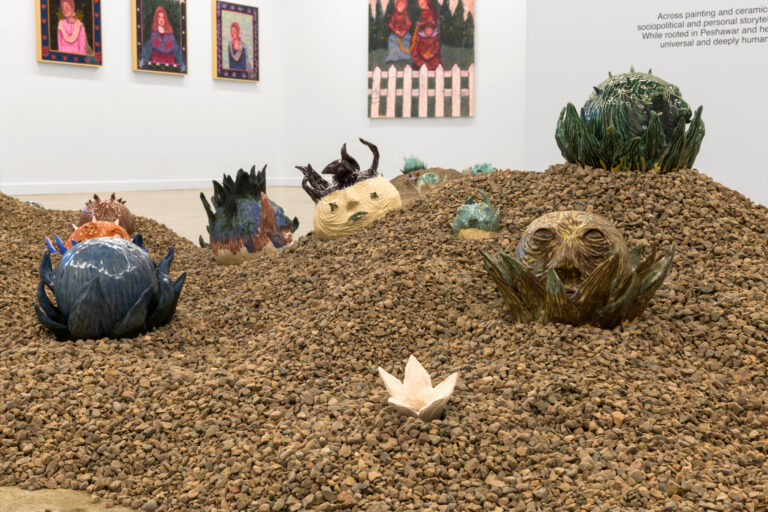
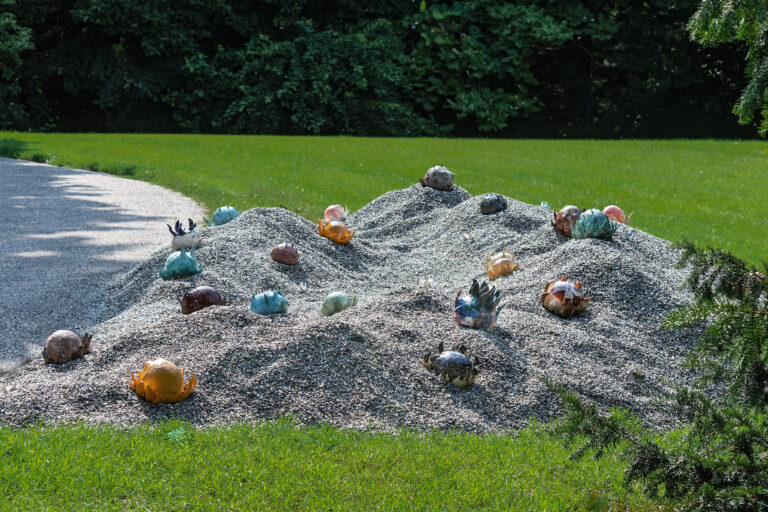
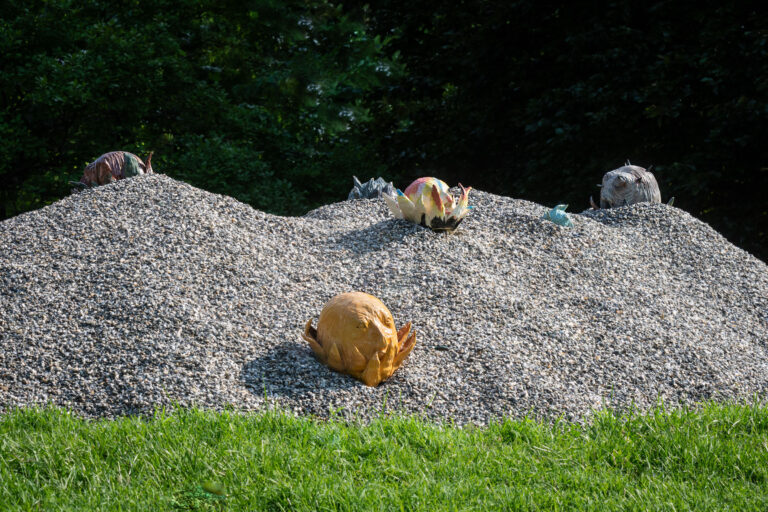
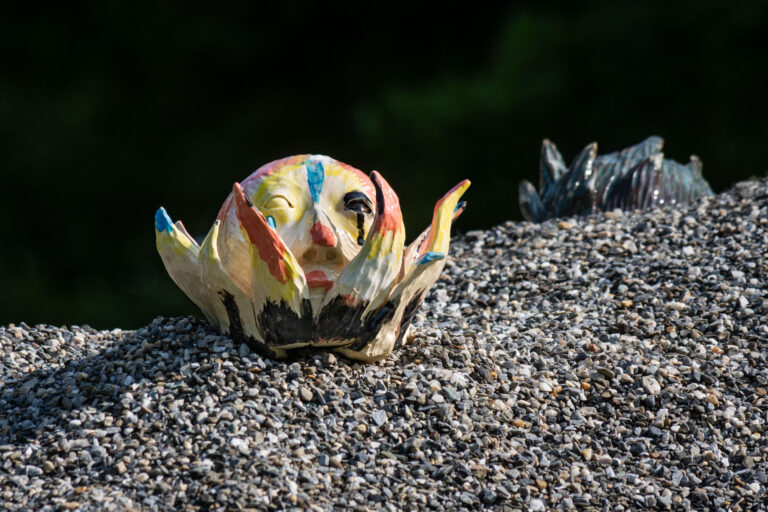
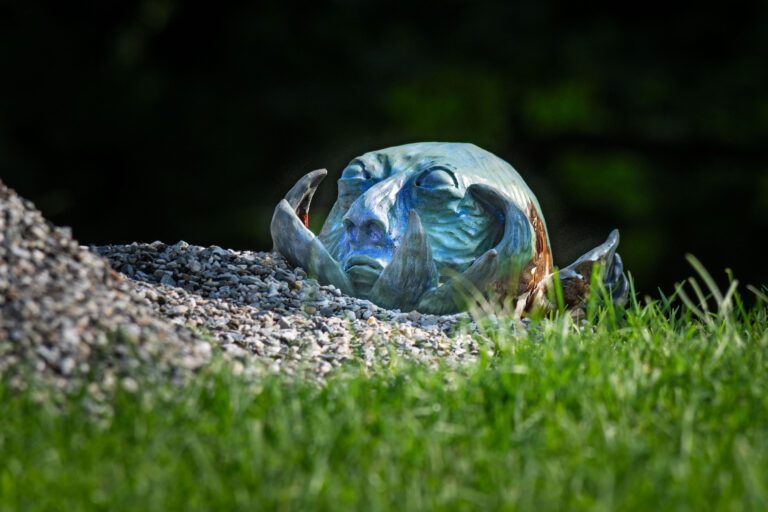
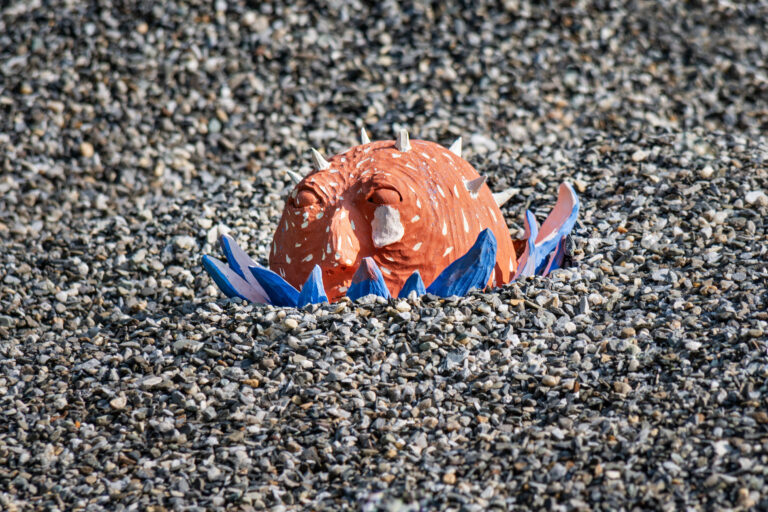
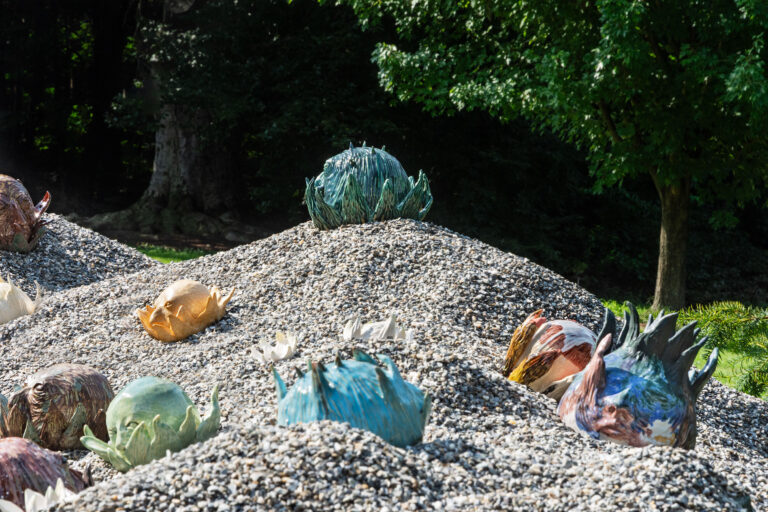
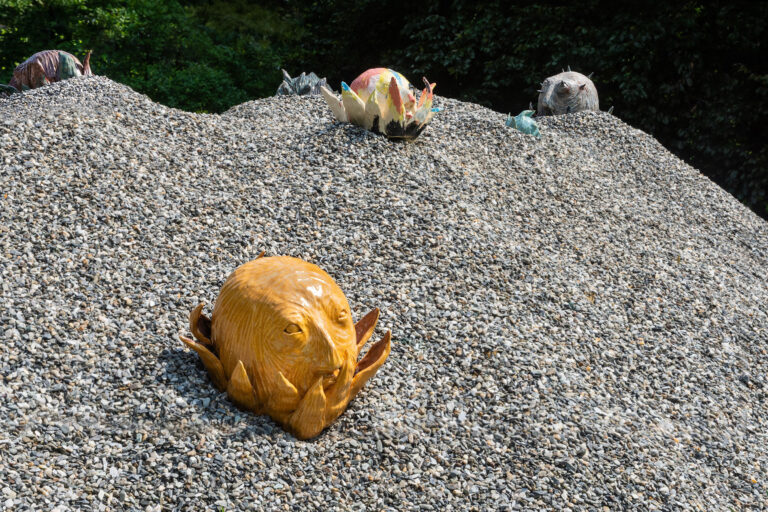
As one approaches Glyndor Gallery, they are met by a series of petaled heads, emerging from a mound of gravel representing an unforgiving and arid landscape. These faces are colorful, yet expressionless. Some of them weep, open-eyed, tears rolling down their round cheeks. Others squint, stare inquisitively, or hide behind their foliage. These flowering beings are Noormah Jamal’s Blooms. Made from glazed ceramics in varied colors, sizes, and textures, Jamal’s installation draws connections between the people of a city and its landscape. Here, the Blooms become a metaphor for the resilience of a people in times of war, climate disaster, colonialism, and poverty.
Jamal, who was born and raised in Peshawar, Pakistan, draws from her Pakhtun culture throughout her work, exploring themes of home, memory, community, and girlhood. From her playful, childlike perspective surfaces a dialogue between past and present, as well as an exploration of the ways one’s selfhood and personal history intersect with collective memory. Being the closest major city in Pakistan to Afghanistan, Peshawar and its inhabitants have also witnessed and been subjected to overwhelming violent conflict, political unrest, and oppression, particularly as a result of the "war on terror" that began in 2001. Throughout Jamal’s work, her lived experience during this period in Peshawar—along with the insight and knowledge gained thereof—converges with nostalgia and fantasy to address complicated socio-political issues with both nuance and hope.
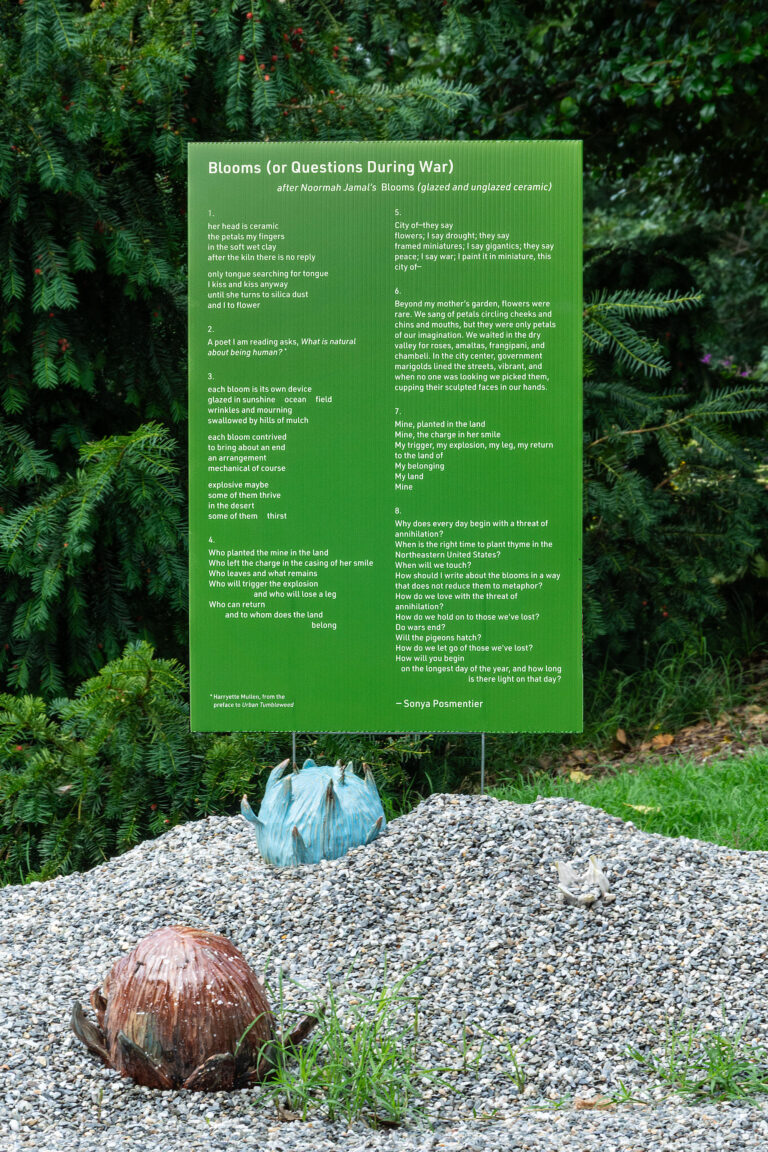
In Blooms, Jamal pays careful and tender tribute to her home and its people, taking inspiration for the installation from Peshawar’s epithet as the “City of Flowers.” Despite its nickname, Peshawar today is a notably dry mountainous region without much greenery. Jamal responds to the supposed irony of the city’s designation, finding meaning in the contradiction: Peshawar’s flowers are its people. Just as Jamal's Blooms grow from a harsh and rocky terrain, the people of Peshawar sprout, persevere, and "bloom" through various traumas, hardships, political turbulence, and inequalities that plague the region. Each sculptural head is distinct, with carved surfaces and textures embedded in the clay to evoke landscape—their differences tell a story of individual identity shaped by inherited narratives, lived experiences, and the ongoing negotiation between belonging and movement. Referencing the human face as a site of recognition and memory, Blooms invites viewers to consider those who remain and must continue to inhabit a place after upheaval. The installation also features a new poem by Sonya Posmentier, responding directly to Jamal's work, asking questions about war, land, and belonging.
Blooms (or Questions During War)
after Noormah Jamal’s “Blooms” (glazed and unglazed ceramic)
1.
her head is ceramic
the petals my fingers
in the soft wet clay
after the kiln there is no reply
only tongue searching for tongue
I kiss and kiss anyway
until she turns to silica dust
and I to flower
2.
A poet I am reading asks, What is natural about being human? *
3.
each bloom is its own device
glazed in sunshine ocean field
wrinkles and mourning
swallowed by hills of mulch
each bloom contrived
to bring about an end
an arrangement
mechanical of course
explosive maybe
some of them thrive
in the desert
some of them thirst
4.
Who planted the mine in the land
Who left the charge in the casing of her smile
Who leaves and what remains
Who will trigger the explosion
and who will lose a leg
Who can return
and to whom does the land
belong
5.
City of—they say
flowers; I say drought; they say
framed miniatures; I say gigantics; they say
peace; I say war; I paint it in miniature, this city of—
6.
Beyond my mother’s garden, flowers were rare. We sang of petals circling cheeks and chins and mouths, but they were only petals of our imagination. We waited in the dry valley for roses, amaltas, frangipani, and chambeli. In the city center, government marigolds lined the streets, vibrant, and when no one was looking we picked them, cupping their sculpted faces in our hands.
7.
Mine, planted in the land
Mine, the charge in her smile
My trigger, my explosion, my leg, my return
to the land of
My belonging
My land
Mine
8.
Why does every day begin with a threat of annihilation?
When is the right time to plant thyme in the Northeastern United States?
When will we touch?
How should I write about the blooms in a way that does not reduce them to metaphor?
How do we love with the threat of annihilation?
How do we hold on to those we’ve lost?
Do wars end?
Will the pigeons hatch?
How do we let go of those we’ve lost?
How will you begin
on the longest day of the year, and how long
is there light on that day?
Sonya Posmentier
*Harryette Mullen, from the preface to Urban Tumbleweed
Public Program: October 18, 2026, 3:15 PM, Meet the Artists: Melanie Brewster and Noormah Jamal. Jamal will be in conversation with poet and NYU professor Sonya Posmentier, activating her installation with a poetry reading.
-
Noormah Jamal
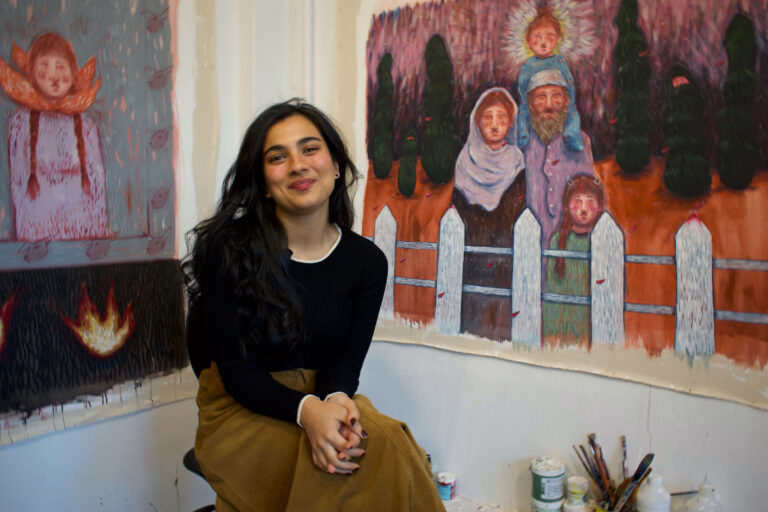
Noormah Jamal
Noormah Jamal is a Brooklyn-based multidisciplinary artist. Her work centers around identity and the personal baggage that people carry. Her image making and sculptures are deeply rooted in the oral histories of her community and family. She has exhibited internationally at Rajiv Menon Contemporary, Los Angeles; Twelve Gates Arts, Philadelphia; Rietberg Museum, Zurich; and Canvas Gallery, Karachi. Her work has been featured in various publications and media including Hyperallergic, the Herald, Artsy, Impulse Magazine, the Karachi Collective and the New American paintings. Currently she is a member of the Elizabeth Foundation for the Arts studio program. Jamal graduated from the National College of Arts, Lahore. She earned an MFA from Pratt Institute, Brooklyn. Learn more about the artist at www.noormahjamal.com.
Photo courtesy of the artist.
-
Sonya Posmentier
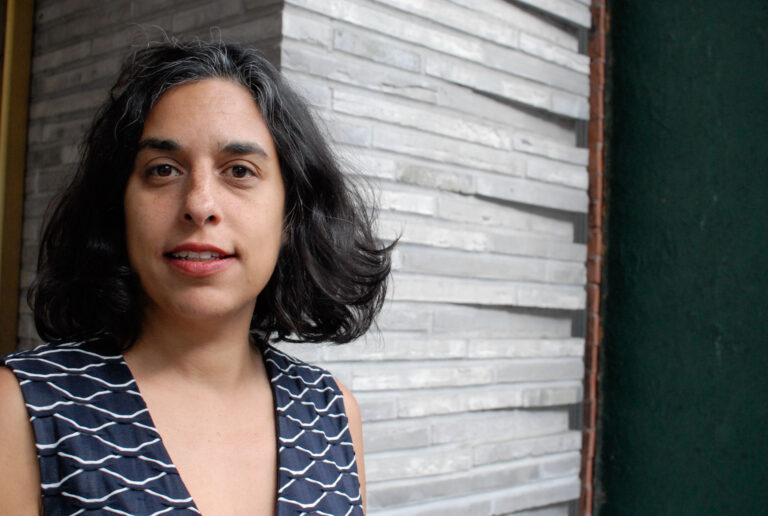
Sonya Posmentier
Sonya Posmentier is a professor and writer in New York City. She is the author of Cultivation and Catastrophe: The Lyric Ecology of Modern Black Literature (2017). Her essays and poems have appeared in The New York Times Book Review, The Yale Review, English Literary History, American Literary History, Public Books, and elsewhere.
Also on view
Know Before You Go
Our tips help you navigate our grounds and protect our living collection—and we have guidelines in place to keep us all safe and well.